Green Country, Oklahoma
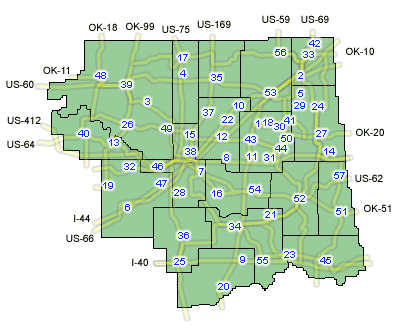
From sprawling cattle ranches to curlicued Art Deco skyscrapers, Osage brush arbors to Route 66 diners, northeastern Oklahoma is where the American Dream met the American West. The area's Native American roots can be traced back to the prehistoric Spiro Mound Builders -- the story of the 12th century empire they built is told at Spiro Mounds Archaeological Park near Poteau. In the 19th Century, the Cherokee tribe built their capitol on the green banks of the Illinois River and Creek Indian councils met under a massive oak in "Tulsey Town." The Osage tribe moved from Kansas to Pawhuska, named for the Osage chief, on the border of the tall grass prairie; the tribe was confident the roots of the rich grass were so thick and deep the land would never be plowed by settlers. The discovery of vast seas of oil beneath the prairies changed the face of northeastern Oklahoma -- Tulsey Town became Tulsa, "Oil Capitol of the World," and nearby Bartlesville grew from a Delaware trading post to a cosmopolitan town boasting a Frank Lloyd Wright-designed skyscraper.
Explore Green Country
National Rod & Custom Car Hall of Fame Museum
The National Rod & Custom Car Hall of Fame Museum is a nationally recognized tribute to the leading street rod and custom car builders throughout the country. The 40,000 Sq. Ft. facility houses over 40
Afton, OK MuseumsOverstreet-Kerr Historical Farm
At the Overstreet-Kerr Farm visitors may glimpse life on this working farm as it was in the early 20th century. See the lavishly restored, 1895, antique filled, 14-room pioneer home that is listed on the National Registry of Historic Places
Sallisaw, OK MuseumsHistoric Springhouse
The Stone Well House was built in the 1840's and is the oldest structure in the city and county. It was used as a water supply at the time for the Cherokee Indian Orphan Asylum. The Cherokee Indian Orphan Asylum was built in 1875 and was located where Salina's Old Gymnasium now stands.
Salina, OK Pioneer HistoryKeystone Lake Fishing
Keystone Lake is noted for its striped bass, sand bass, black bass, lake strain small mouth bass, crappie, and catfish. Downstream fisheries are accessible from Whitewater and Brush Creek Parks. Swift Park (a day use Tulsa County park)
, OK FishingRogers County Courthouse
The county dedicated its first Court House in 1937, 30 years after statehood. The decision was made to purchase the property and went to the vote of the people. The bond issue failed twice but finally carried on the third try. There have been several additions to the original building.
Claremore, OK Historic CourthousesThe Battle of Cabin Creek
Although Vinita wasn't founded until 1871, there was a great number of settlers in the area before then. Not far from Vinita, Cabin Creek, was the site of two Civil War battles. The first battle fought in early July of 1863, crediting the Buffalo Soldiers resulted in a Union victory. In 1864
Vinita, OK BattlesitesStarr Springs Monument
The Starr Springs area was first settled by the Benjamin Cooper family in 1834. It was the site of the Andrew Adair and George Washington Adair massacre in 1853
Stilwell, OK MonumentsFountainhead Golf Course
Fountainhead Golf Course is one of Oklahoma's nine state park golf courses. Tight undulating fairways, large sloping greens and sand bunkers characterize Fountainhead - a test of ability for any golfer. Fountainhead'
, OK Golf CoursesWill Rogers Center
The WILL ROGERS HOTEL, listed on the National Register of Historic Places was dedicated in 1930. The fireproof structure of concrete and steel originally contained 78 rooms and 7 apartments. During World War II, it was designated as a bomb shelter. Mineral water baths called "radium water"
Claremore, OK Historic HotelsOld Baptist Mission
The establishment of the Baptist Mission marked the end of the Cherokee Trail of Tears. Sunday services are still held in the 1888 church. The historical marker on the front lawn reads:
"About 4 miles north and west
Establsihed by Rev. Jesse Busyhead in 1839
Westville, OK Historic Churches
Glass Mansion
Another facility owned and operated by the Nowata Historical Society, the Glass mansion, better known as "The Glass house," is as fine a structure as many found in larger cities of the country. Built in 1883
Nowata, OK Historic HomesWagoner City Historical Museum
Wagoner's City Historical Museum is an alive and vital showcase for one of the finest historic fashion collections in Oklahoma, with artifacts of area history to give local residents and tourists alike a real appreciation for how things used to be.
Wagoner, OK Museums