Great Plains Country, Oklahoma
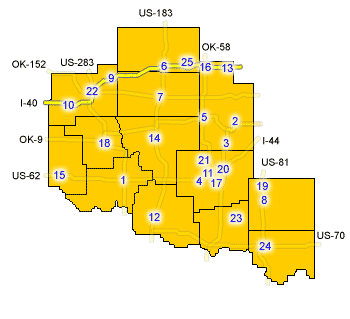
In southwestern Oklahoma the golden shortgrass prairie extends for mile after undulating mile, mirroring the sky in its vastness. Less than a century and a half ago, the Southern Plains were the domain of the Kiowa and Comanche, who hunted buffalo on horses bridled with Spanish silver and traded with the Wichitas, farmers who lived in grass houses. To the Kiowa, the earth was sacred, and the Wichitas believed their ancestors lived on in the 650-million-year-old granite boulders of the Wichita Mountains. Travelers exploring the region today may encounter moments of similar reverence -- watching the sun set from atop Mount Scott in the Wichita Mountains Wildlife Refuge, for instance, or watching an eagle soar in winter. A rowdier spirit lives endures in the area, too: Teddy Roosevelt created the wildlife refuge after he traveled to Oklahoma Territory to hunt wolves. Bison now graze on the 60,000-acre preserve, along with longhorn cattle, antelope and elk -- rugged mountain biking, hiking, camping and backpacking are permitted in some areas.
Explore Great Plains Country
Quartz Mountain Rock Climbing
Discover the rugged geology of Quartz Mountain Resort Park which is surrounded by the stark beauty of rough granite hills and outcroppings, remnants of the Wichita Mountain Range, whose peaks once stood over 20,000 feet tall. The park'
, OK RappellingMattie Beal Home
The Historic Mattie Beal Home is a 3,580 square foot, 14-room mansion constructed in 1907-1909. It sits on a portion of the 160-acres selected by Mattie Beal, the young woman whose name was drawn second in the Kiowa-Comanche-Apache Land Lottery of 1901
Lawton, OK MuseumsElk City Municipal Golf Course & Country Club
18 hole Public Golf Course with Snack Bar. Country Club - Swimming Pool - Lounge - Restaurant Pro Shop - Green Fee's &
Elk City, OK Golf CoursesOn The Chisholm Trail Statue
Oklahoma's largest bronze sculpture (16' high and 35" long) stands in Duncan, adjacent to the museum. The sculpture shows a chuch wagon followed by longhorn cattle on the move northward. Cowboys are intent on the herd. Of interest to young observers is the trail dog trotting alongside.
Duncan, OK ArtsClinton-Sherman Industrial Airpark
Clinton-Sherman Industrial Airpark (CSIA), formerly Clinton-Sherman Air Force Base and Clinton Naval Air Station, encompasses approximately 3,000 acres in western Oklahoma adjacent to the town of Burns Flat. The Air Force closed the facility in 1969. In the summer of 1971
Burns Flat, OK MilitaryGreat Plains State Park
Great Plains State Park is located on 6400-acre Tom Steed Lake west of the Wichita Mountains in Kiowa County near the town of Mountain Park. A drive along Hwy 183 provides a scenic route that winds its way through the mountains along the lake'
, OK State ParksLittle Chapel
The Little Chapel was built in 1902 and is believed to be Lawton's oldest remaining public building. Its stained glass and restored antique organ are a highlight of any visity to Lawton .
Lawton, OK Historic ChurchesFort Sill Museum
The Fort Sill Museum has 26 historic buildings including seven with exhibits on the Frontier Army, Native Americans and Field Artillery. One of the these, the Old Post Guardhouse erected in 1873
Fort Sill, OK Museums